
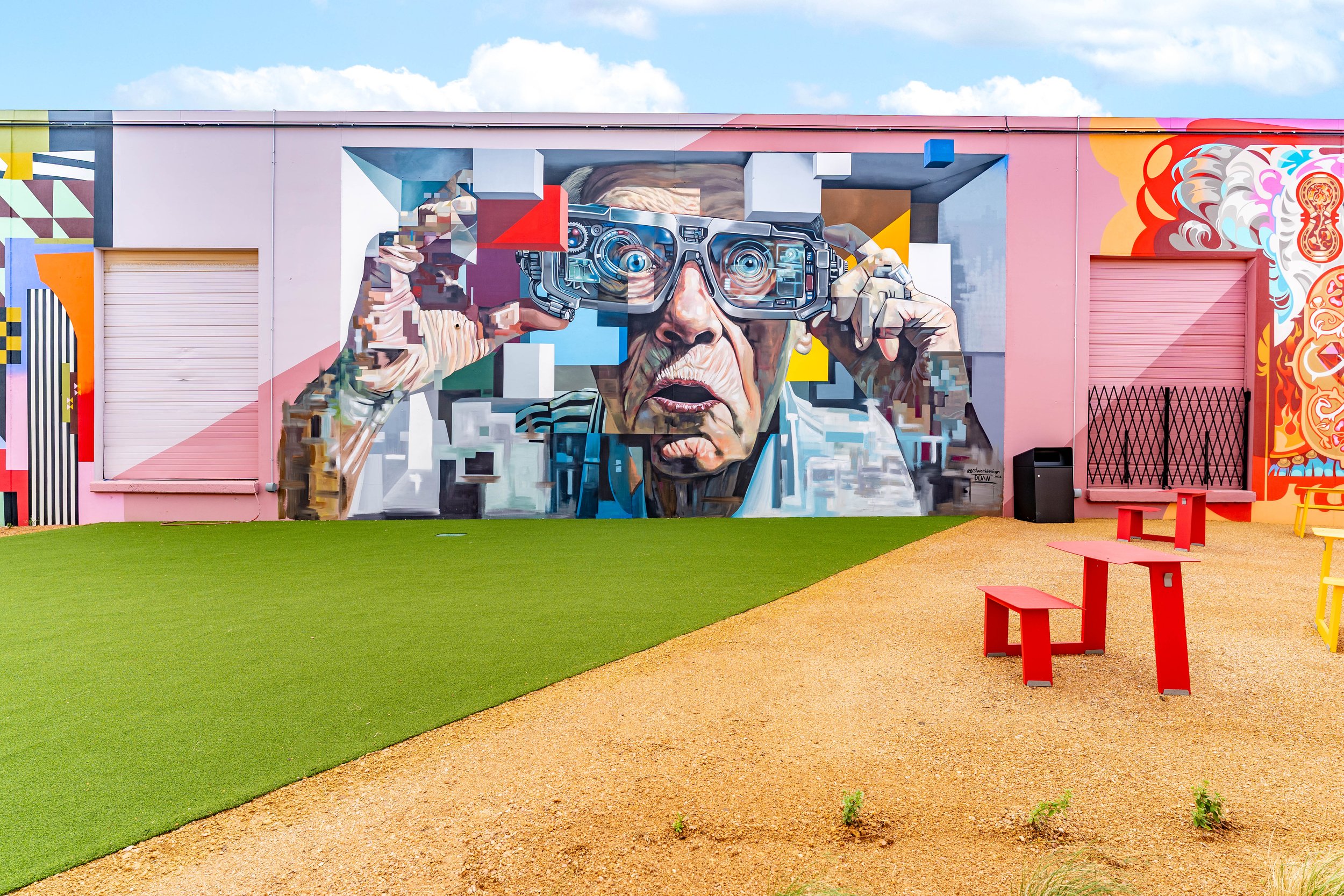
Sıtkı is a street artist, hailing from Istanbul, Turkey. His work lives at the intersection of illusion and reality. He uses trompe l’oeil and three-dimensional techniques to transform flat architectural surfaces into immersive visual experiences that challenge how we perceive the built environment. “This mural presents a hyper realistic elderly figure wearing advanced virtual reality glasses, surrounded by fragmented geometric forms and cubist compositions that appear to break free from the wall surface. The concept explores the tension between analog human experience and digital evolution. The figure embodies a generation rooted in physical memory and tactile knowledge, now encountering technology that reshapes how we see, learn, and connect. The mural becomes a metaphor for the very subject it portrays: the blurring line between what is real and what is constructed.”
behind the mural
-
My work lives at the intersection of illusion and reality. I use trompe l'oeil and three-dimensional techniques to transform flat architectural surfaces into immersive visual experiences that challenge how we perceive the built environment. Every wall I approach is an opportunity to dissolve the boundary between what is physically there and what the eye believes it sees.
At The Art Docks, this philosophy takes on a deeper dimension. The mural presents a hyper realistic elderly figure wearing advanced virtual reality glasses, surrounded by fragmented geometric forms and cubist compositions that appear to break free from the wall surface. The concept explores the tension between analog human experience and digital evolution. The figure embodies a generation rooted in physical memory and tactile knowledge, now encountering technology that reshapes how we see, learn, and connect. Through trompe l'oeil depth, cast shadows, and carefully controlled perspective, the mural itself becomes a metaphor for the very subject it portrays: the blurring line between what is real and what is constructed.
-
Public art breathes with the city. Unlike a gallery piece protected behind glass, a mural lives in weather, in traffic, in the rhythm of daily life. It meets people where they are, without asking for a ticket or an invitation. That accessibility is what makes it powerful. A mural can shift how someone feels about a street they walk every day.
For Dallas and for any community, public art creates unexpected moments of reflection. It slows people down. It makes them look up. In the case of this mural, I hope viewers feel a moment of genuine wonder, the same kind of wonder the elderly figure in the piece is experiencing. I want someone walking past to pause and feel the scale of the illusion, to question where the wall ends and the image begins, and then to think about their own relationship with technology, aging, and curiosity. If a child asks a grandparent about the man in the glasses, or if someone stops to take a photo and starts a conversation with a stranger, the mural has done its job. Public art turns passive urban space into active shared experience.
-
Every project begins with the wall itself. I study the architecture, the sightlines, and the surrounding environment before I ever open a sketchbook. For this piece, the scale and proportions of the surface at The Art Docks shaped the entire composition. I needed a subject large enough to command the space and complex enough to reward close viewing.
The concept emerged from a question I have been thinking about for years: what happens when the generation that built the analog world encounters a fully digital future? I began sketching elderly faces with expressions of astonishment, then layered in the virtual reality glasses as a visual bridge between two eras. The cubist and geometric fragmentation around the figure evolved through digital mockups in Photoshop and Procreate, where I tested how three-dimensional blocks and color fields could interact with the trompe l'oeil portrait to create a sense of physical depth.
The color palette draws from bold, saturated tones set against neutral architectural grays. Vivid reds, blues, oranges, and geometric color blocks contrast with the photorealistic skin tones and textures of the figure, reinforcing the dialogue between the organic and the digital. Composition, color, and illusion all serve the same story.
-
This mural was executed with a combination of spray paint and acrylic paint, each serving a specific purpose. Spray paint allows me to build the soft gradients, atmospheric depth, and photorealistic skin textures that trompe l'oeil demands. Acrylic comes in for precision work: clean geometric edges, controlled color blocks, and the fine detail in the virtual reality glasses and mechanical elements.
Working at this scale always presents unique challenges. Maintaining consistent perspective across a large surface requires constant reference checks, stepping back repeatedly to evaluate sightlines from the viewer's intended vantage point. The hyper realistic face especially demands accuracy in proportion and value; a small miscalculation in shadow placement can break the entire illusion at full scale. Weather and surface texture also play a role, as every wall absorbs paint differently and conditions change throughout the day. One of the most rewarding moments was seeing the three-dimensional geometric elements begin to visually lift off the wall as the shadows and highlights locked into place. That is the moment where the painting stops being paint and starts becoming space.
-
If someone stands before this mural ten years from now, I want them to understand that it was created at a pivotal moment in human history, a time when artificial intelligence and digital technology were accelerating faster than most people could process. The mural captures that exact feeling of standing at the threshold between what we know and what we cannot yet imagine.
I want them to know that the artist behind it believed deeply in the power of illusion to tell the truth. That walls can speak. That a flat surface can hold genuine depth, not just visually but emotionally and intellectually. And perhaps most importantly, that curiosity has no expiration date. The elderly figure in this mural is not confused or left behind. He is looking forward, seeing the future through new eyes, and that image of wonder is meant to last far longer than any single technology.
-
"Touch" by Daft Punk (feat. Paul Williams), from the album Random Access Memories.
This eight-minute composition traces the journey of a consciousness moving between memory and discovery, between the analog past and the digital unknown. It opens with fragmented, almost bewildered vocals before building into a sweeping orchestral passage that feels like stepping into a new world for the first time. The song captures exactly what the mural portrays: the deeply human experience of encountering something beyond your frame of reference, and finding not fear, but wonder. When the choir sings "Hold on, if love is the answer, you are home," it mirrors the mural's central message that technology, at its best, brings us closer to understanding rather than further from it.