
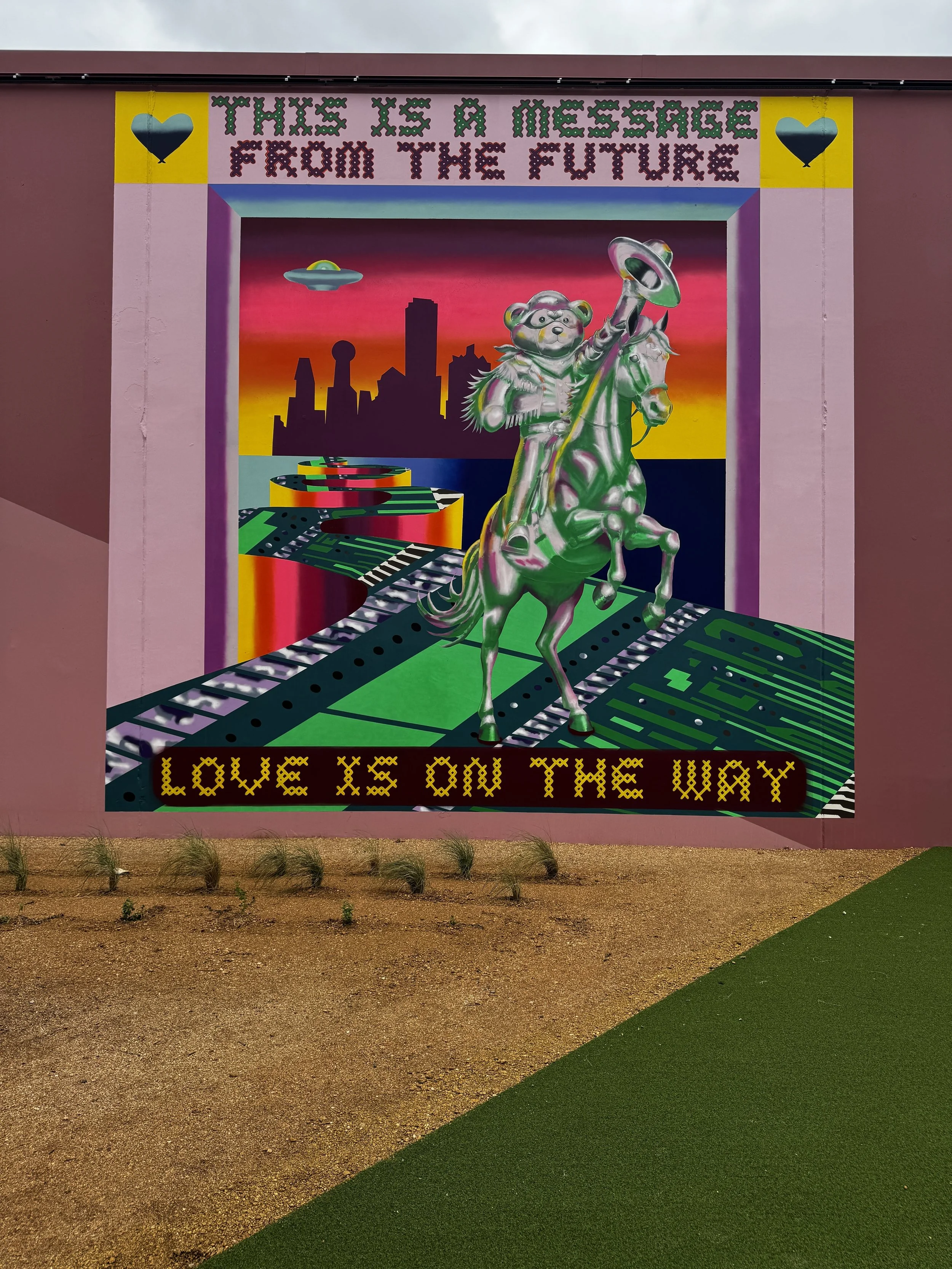
Kim Brewer was born in Fort Worth, Texas and received her MFA from Texas Woman’s University. At the core of her work is a belief that art should be an accessible bridge—something that connects, supports, and affirms our shared humanity. Her mural embodies this philosophy through both text and imagery. The presence of Teddy evokes childlike wonder, vulnerability, and a sense of emotional openness. These elements invite viewers to pause, soften, and reconnect with parts of themselves that often go quiet in adulthood. “I gravitate toward square formats because I enjoy the balance and challenge they offer; guiding the viewer’s eye within that shape feels like a puzzle I never tire of solving. My palette blends muted tones with neon accents. The neon colors in this mural aren’t just decorative—they function as light sources that illuminate Teddy Stardust, making their presence essential to the piece’s emotional and visual impact.”
Behind the mural
-
At the core of my work is a belief that art should be an accessible bridge—something that connects, supports, and affirms our shared humanity. My mural in The Art Docks embodies this philosophy through both text and imagery. The presence of Teddy evokes childlike wonder, vulnerability, and a sense of emotional openness. These elements invite viewers to pause, soften, and reconnect with parts of themselves that often go quiet in adulthood.
-
Public art lives in the rhythm of a city—it’s encountered by people who may never step into a gallery, and that accessibility is essential. As someone who has long woven social justice into both my life and my practice, I believe public art is a vital resource for any community, including Dallas. Art has the power to motivate, educate, inspire, and empower. My hope is that as people walk past this mural, they feel seen, uplifted, or even momentarily comforted. If it sparks reflection or offers a moment of emotional rest, then it’s doing its job.
-
My design process usually begins with a vision that forms in my mind’s eye. I often write first, letting language clarify the emotional tone of the piece. From there, I begin building the visual components in layered mockups on my tablet. This stage is incredibly freeing—I can experiment, rearrange, and refine until the composition feels right.
I gravitate toward square formats because I enjoy the balance and challenge they offer; guiding the viewer’s eye within that shape feels like a puzzle I never tire of solving. My palette blends muted tones with neon accents. The neons in this mural aren’t just decorative—they function as light sources that illuminate Teddy Stardust, making their presence essential to the piece’s emotional and visual impact.
-
Creating my first mural as a studio artist came with a steep learning curve. My studio practice relies heavily on masking, cutting, and achieving crisp, hard‑edged lines paired with soft airbrushed gradients. Translating that labor‑intensive process outdoors introduced new challenges: wind, humidity, and the sheer physicality of working at scale.
I began by sketching the design onto the wall, then applied masking film and used an X‑acto knife to cut out each area to be painted. I incorporated spray paint, rollers, and airbrushing to achieve the layered textures and lighting effects I envisioned. Scaling the work up was both the hardest and most rewarding part of the process. Seeing something that lived in my mind—and on a small tablet—expand into a mural with real presence was indescribable. I hope the community feels that same sense of impact when they encounter it.
-
If someone stands in front of this mural ten years from now, I hope they feel the presence of someone who loved fiercely and poured that love into creating something meant to help others feel held, seen, or cared for. That emotional imprint is the legacy I hope endures.
-